Thursday, May 14, 2009

A thought on vaccine technology


Graphic of H1N1 confirmed cases in the US, May 14, 2009, from the CDC


With influenza A(H1N1), or swine flu, stirring up fears of flu pandemic and a potential need for mass vaccination against H1N1, it seemed fitting to consider the technology of vaccines for various viral illnesses, from seasonal flu to HIV.

A shot every year that still doesn't keep the flu away? What happened to an apple a day?

Influenza A strains easily form new strains and quasi-species via a relatively high critical error threshold for the virus, reassortment of the segmented genome, and a much slower process of genetic drift. The resultant diversity means that a new vaccine is developed each year, and may not even include the breadth of diverse strains that the human population may see during that flu season. A group at Harvard recently published promising evidence that it may be possible to produce a smaller group of vaccines that would confer immunity to any influenza A (Sui et al 2009, Nature Structural and Molecular Biology, Vol16, No3). Influenza A virions possess two major surface proteins: hemaggglutinin, for cell entry; and neuraminidase, for cell exit. Sui et al. screened a library of antibodies to locate those with high affinity antibodies to a common epitope source: the pocket in the stem of hemagglutinin. This particular epitope has two variants, meaning that its possible that two anitbodies could recognize all hemagglutinin surface proteins of all influenza A strains across many years. The preventative influenza agent, Tamiflu, is a neuraminidase inhibitor; but it doesn't always work (if administered post-infection), and there is general concern about potential increases in strain resistance. Sui et al. demonstrated that in mice, one of the high affinity antibodies toward hemagglutinin (nAb C179) blocked membrane fusion of H5N1 (avian flu), thereby protecting the mice from viral challenge. Thus, a new era of more efficient (and maybe efficacious too) flu vaccine development seems to be on its way. The Sui et al. paper is only one of several recent breakthroughs in this emerging field of a "universal" flu vaccine (editorial: Leslie M. (27 Feb 2009) "Flu antibodies stir new hope for treatment, vaccine." Science, DOI: 10.1126/science.323.5918.1160).


A graphic from Science magazine on the structure of influenza A

What about viruses for which we have no good vaccines?

HIV, HCV, and other other viruses that cause chronic disease pathologies have not been addressed with a bad vaccine technology, let alone a good one. In January, I saw a really interesting talk at UNC by John Essigmann on "Viral Acceleration Decay" (VDA). My interest in Dr. Essigmann's talk was a studious effort at best, because I expected him to talk mainly about DNA adducts and cancer--and he did. Except he also talked about his pharma start-up, Koronis, and the team's efforts to very roughly, give HIV cancer, and kill it in the host. The general idea behind VDA is eye-opening. The replication rate of HIV is very high, and it exists close to the edge of its critical error threshold, or the number of errors within the replicated genome that are tolerable by the virus. Essigmann et al. at Koronis had an idea; give a drug that is a promutagenic nucleoside analog that is incorporated by the reverse transcriptase, and eventually, too many errors will result in an abolishing of viral replication, and a decrease in viral load, until the the virus "dies." This hypothesis and the original work to demonstrate its plausibility are detailed in Loeb et al. (1999) "Lethal mutagenesis of HIV with mutagenic nucleoside analogs."

Existing treatment for HIV includes antivirals: acyclovir, lamivadine, zidovudine (AZT) -- all of these are nucleosides with a modified sugar and unmodified bases, and are intended to block reverse transcriptase replication. Clearly they are never able to abolish viral replication completely. The Koronis nucleosides contain the natural sugar group of the nucleoside, and have a modified base. This promutagenic nucleoside results in transition mutations (A<>G, C<>T). One such nucleoside is in the clinical trials process, stalled in Phase II (see http://www.koronispharma.com/ and Harris et al KP1212/1461, a nucleoside designed for the treatment of HIV by viral mutagenesis).

I'm excited to start thinking about vaccines and viral treatment in a different way. So perhaps there is a positive outcome from the H1N1 outbreak - more funding and attention for influenza vaccines, and other vaccines technologies.

Monday, May 4, 2009

Why I sweat through the NC summer in pants


Recently I began working in a new lab to complete a side project funded by a small grant from the Society of Toxicology and Colgate-Palmolive. This has provided an interesting affirmation of ideas I've begun learning as a young scientist, as I've now only trained in at least 5 (depending on how you count it) research labs at three institutions.

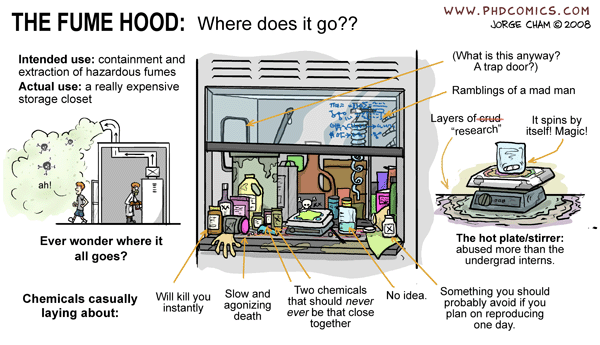
The primary investigator is a well-known, successful researcher in the area of hepatobiliary toxicity of pharmaceuticals. I respect her and like her very much. What I didn't expect were the cramped, often overly-political, and under-stocked and under-funded conditions of her laboratory. There are no less than 10 people working on 2 cramped benches, with glassware and other materials everywhere. There are two stools for the lab, which means one has to bend over the bench. Safety procedures are inconsistent - it's not uncommon to see shorts, open-toed shoes, no lab coat, etc. And other procedures - such as using vinyl sleeves over lab coats at BSL2 cell culture hoods - are inconsistent (i.e. in one room we wear them, and at the other hood, we don't, with no real explanation). Training seems haphazard. Disposal rules are not clear. Tools used in radioactive experiments are not dedicated radioactive tools, and wipe tests after work are not conducted. I could go on.

Then today I read this article about a graduate student at UCLA died from lack of safety procedures in a lab.

This article aligns with my experience - that academic labs are definitively more lax about safety. Some are worse than others. The first lab I trained in at Virginia Tech was wonderful, had clear procedures, clear storage of materials, clear safety rules, etc. At EPA, I've often felt that some procedures seem overly arduous, that waste streams are complex, or that maybe it would be okay to wear capris just once! Or that it seems ludicrous to wear a lab coat to label tubes. Or that I'd love to wear shorts and flip-flops to work like my academic counterparts in the middle of 100 degree+ NC summers. However, what I'm learning is that EPA has really chosen a responsible, hard-lined approach . . . that I actually miss and love.


Importantly, the big difference I'm finding is that a great laboratory technician, who chooses to be firm on procedures, safety, and operation of the lab, is the biggest key for lab safety and productivity.

Wednesday, April 8, 2009

Passover Special: The 2nd Plague of Egypt

Though Passover commemorates the sparing of the firstborn during the 10th plague on Egypt from Exodus, it would appear that National Geographic this month highlights something of a 2nd plague - the plague of frogs. Recalling from story of Exodus, frogs came out of the water and overran Egypt, until Moses collaborated with the Pharaoh to pick the time that the plague would end, in order to prove "beyond doubt" that it was a divine punishment for enslavement of the Israelites (okay so, I'm not a Biblical scholar, but this is the idea of I think).

Then, at once, all of the frogs died.

(See the excellent National Geographic pictures)

A long list of potential explanations for amphibian loss internationally:
-Habitat loss
-Global warming
-Chytrid fungus
-Invasive species/predators introduced accidentally or intentionally
-Chemical/pollutant exposures that affect processes including metamorphosis and reproduction
-etc.


It's really not easy being green.

However, chytrid fungus, or Batrachochytrium dendrobatidis (Bd), is now a leading cause of amphibian death internationally. The decline and extinction of greater than 200 amphibian species is attributable to this fungal infection (interestingly, the fungus digests keratin, so tadpoles are less sensitive to it than adults) (Natl Geographic & Harris et al 2009). Automatically, questions arise including: is chytridiomycosis an effect of anthropogenic forces? What can be done to stop it?

An interesting study from Harris et al. (2009) demonstrates that in a laboratory setting, skin microbes, specifically Janthinobacterium livium, produce antifungal and anti-Bd metabolite, violacein. So a potential treatment option is to enhance the native microbial populations on frog skin to increase the amount of anti-Bd violacein. Is this a smart ecological management move? What will happen upon introduction of certain bacterial species? Clearly a responsible path could be forged here by selecting already native bacteria found on local frog populations, but clearly there will have to be careful planning.

Another study evaluates correlative and causal relationships between global climate change and Bd impacts on the amphibian population. An existing hypothesis had been that global warming enabled a convergence of daytime and evening temperatures that favor the growth of Bd. Rohr et al. (2008) demonstrate that while temperatures can predict Bd spread/mortality in amphibians, other variables are better predictors of the impacts, including local banana and beer production. The strength of evidence for temperature prediction of Bd outbreak is interesting, but not causal. This suggests that other factors contributing to the spread and virulence of the infectious Bd are uncharacterized at this time - so global warming may contribute, but clearly other factors are interacting with the climate conditions.

One question in my mind is another anthropogenic hypothesis: how does contamination of surface waters with various PPCP potentially disrupt the antifungal, microbial communities of amphibian skin? In vitro, pharmaceuticals may disrupt bacterial biofilms that provide niche organization, shared metabolic processes that are symbiotic or parasitic in nature, protection against toxic substances, and protection from predators. Schreiber et al. (2008) evaluated amoxicillin, erythromycin and phenazone due to their high persistence in the environment. These compounds are found at ug/L or ng/L concentrations in groundwater and surface waters. The lowest observable adverse effect level (LOAEL) for decreased adhesion occurred with amoxicillin; E.coli and B. subtilis adhesion was inhibited on uncoated polystyrene at 50 ug/L and 0.5 ug/L amoxicillin, respectively. However, amoxicillin under differing experimental circumstances could also increase adhesion. Further, it is unclear how much of an adverse effect this may be in the overall environment. Environmental adhesion decreases may be affected by the total chemical load. Pharmaceutical effects on biofilm formation in this study appear dependent on the specific compound, and the use of iron- or non-iron-coated surfaces.

While it is not truly possible to extrapolate this evidence to the bacterial niche of frog skin, I wonder if there could be a connection between frogs living in water that is polluted with low doses of PPCP, and the virulence of Bd. Something at least to think about.

Not that every environmental consequence has to be anthropogenic, it just would seem that since we are in the middle of the 6th mass extinction, and that we may be contributing, some of these ideas might be worth investigating. Certainly it could be some environmental process. I wonder if there is any archaeological data on whether or not chytrid was the blight that emptied the waters of Egypt? It would be really interesting if it were somehow possible to explain the "plague" through a recurring environmental process like chytrid.

And with that, a Good Seder to you.

Tuesday, April 7, 2009

The Mekong giant catfish, though not cuddly, is adorable enough to save


TIME article

This month's issue of TIME reported on just a few of the most endangered species of the world. Most were not surprising. However, the Mekong giant catfish is startling at the least. If the shock of its size is not enough, imagine it's context - imagine an American soldier in the 1960s on the Mekong seeing a giant catfish for the first time.

Pangasianodon gigas is one of the largest freshwater fish, and it is migratory. Migrating fish face fierce foes: proponents of dams. For a great example of how we can create danger for fish right here at home in the US, see "salmon" and "Pacific Northwest." Some tributaries of the Mekong River, including the Mun River of Thailand (for discussion of dams and migratory patterns of giant catfish, see Hogan et al., 2004 "The Imperiled Giants of the Mekong").

Impaired migration might be one reason for their "critical" endangered status. But what else? The fish is legally protected from hunting, yet this might still contribute a portion of its decline. Something interesting to consider might be - did the Vietnam War have some environmental impact on them? Is their plight isolated, or are other aquatic and terrestrial organisms similarly diminished in the area? Is the effect on the giant catfish due to its place as a predator of many fish, fish that may be contaminated with legacy chemicals?

While I'm sure someone has potentially connected these dots, I haven't been able to find a direct statement. Of the herbicides used during the Vietnam War for defoliage and destruction of crops, Agent Orange comprised 61% of the 72 million liters used. Agent Orange is a 50/50 mixture of 2,4-D and 2,4,5-T; both toxicants in their own right (as well as endocrine disruptors!), the mixture was often contaminated with dioxin, a known carcinogen and thyroid disruptor among other effects. A report from 2001 (and others from the early 2000's) suggest that dioxin levels in the soil, water, wildlife, and human sera/breast milk of residents of Vietnam contain dioxin levels similar to the 1980's - i.e. they are relatively stable. So dioxin is a persistent nightmare for Vietnam, especially areas close to historic military storage areas, and the dioxin present from military installations may still be leaching into the environment (see PMID 11993628, Dwernychuk et al. 2001).

Though elevated dioxin in fish can be confirmed, it doesn't connect back to whether or not this contributes to the collapse of the Mekong giant catfish. Monitoring and tracking of the fish is a last ditch effort to save it - maybe when they tag those fish, they could get a blood sample for a dioxin test?

All of that anxiety in fish really does help their food chain function

Though the I'm late to the scene on this issue, it's become something of great interest to me in my studies of pharmaceuticals and personal care products (PPCP) in the environment. A confluence of analytical chemistry breakthroughs and environmental toxicology has produced concern regarding fluoxetine and other selective serotonin reuptake inhibitors in treated and untreated surface waters. The US Geological Survey began measuring prescription, nonprescription, and personal care products in streams nationally at sub-parts per billion concentrations (Kolpin et al., 2002). Emerging concern regarding the aquatic ecotoxicology of antidepressants discharged into effluents from municipal wastewater treatment plants began in 2003, when Bryan Brooks et al. at Baylor University was able to demonstrate effects of SSRIs on the survival and reproductive fitness of several species of aquatic biota (Brooks et al., 2003). Internationally, communities became concerned about environmental effects, as well as the potential for human exposures.

Only a few endpoints in few species are currently available for the effects of SSRIs on the behavior of fish. Hybrid striped bass (Morone saxatilis x M. chrysops) exposed to fluoxetine experienced concentration- and duration-dependent decreases in the ability to capture prey, evaluated as increased time to capture and eat prey (Gaworecki and Klaine, 2008). Interestingly, the bass were exposed for 6 days, and then allowed to recover for 6 days, and yet the effects persisted. The LOEC for decreased predator ability in the hybrid bass was 23.2 µg/L (Gaworecki and Klaine, 2008). These behavioral effects were anchored to brain concentrations of serotonin; serotonin levels were depressed to 24, 28, and 49% of control by 23.2, 51.4, and 100.9 µg/L fluoxetine by day 9 in the experiment, or half-way through the recovery period. By day 12, the levels of serotonin in the treated groups had recovered, but not completely to control levels. Thus, chronic, sublethal exposure to fluoxetine or other SSRIs may have lasting effects on serotonin and serotonin-regulated predator-prey activity in bass (Gaworecki and Klaine, 2008). The changes in behavior indicate a potential population effect, but behavior is not a regulatory endpoint (Gaworecki & Klaine, July 2008, PMID: 18547660; also see Scientific American article ).

Chronic 91-day exposure, from neonate to adulthood, of Western mosquitofish to fluoxetine resulted in behavioral changes including increased lethargy for concentrations greater than 0.5 µg/L fluoxetine. At 534 µg/L fluoxetine, mosquitofish stayed at the surface and layed on their sides with little to no swimming movement. At 53 µg/L fluoxetine, fish were less responsive, and less severe effects were observed in 5 and 0.5 µg/L fluoxetine. The LOEC for lethargy and decreased movement/responsiveness in this study is 0.5 µg/L fluoxetine, while the NOEC would be 0.05 µg/L fluoxetine (Henry and Black, 2008). It is difficult to decide if slightly decreased activity observed in this experiment is actually an adverse effect. Since moderate effects began at 53 µg/L fluoxetine, this appears to be the concentration eliciting an adverse effect.

Previously, increased endogenous serotonin levels in the brain of rainbow trout Oncorhynchas mykiss were demonstated to correlated with decreased competitition and increased submissive behavior (Overli et al., 2004). Changes in the brain serotonin levels of fish could potentially decrease this competitive ability, perhaps reflected in the “lethargy” noted by Henry & Black (2008) in mosquitofish. However, population effects of these behavioral changes are not currently understood and not easily extrapolated from this limited behavioral data set.

However, before anyone freaks about what SSRIs in surface waters might be doing to fish at both the individual and population level due to modulation of behavior, it's important to keep in context the concentrations being used. Fluoxetine, only one of five major SSRIs, has been measured at several national and international impacted sites, or sites suspected to have higher concentrations of wastewater pollutants. Further, the highest concentration of fluoxetine to date (published in the literature) was in groundwater, at 56 ng/L (Barnes et al 2008). Thus, the concentrations being used in the Gaworecki (2008) study and others are 1000 times greater than those currently present in the environment (as far as we know). The major uncertainty that could diminish this margin of safety is the behavior of the complex PPCP mixture. And at this point that's too complex to tackle.

But, one could, say, carry out a "concentration addition" of the highest reported environmental concentrations and use this to model the effects of all SSRIs in surface waters. This is an idea based on a study using daphnia and algae, where addition of all concentrations of the five SSRIs is appropriate to predict the effects of the mixture (Christensen et al., 2007; Henry and Black, 2007). Still, mixtures modeling is the most interesting area for SSRIs in water - how does the mixture act, and can low doses of all of the SSRIs add up to physiological impacts?